
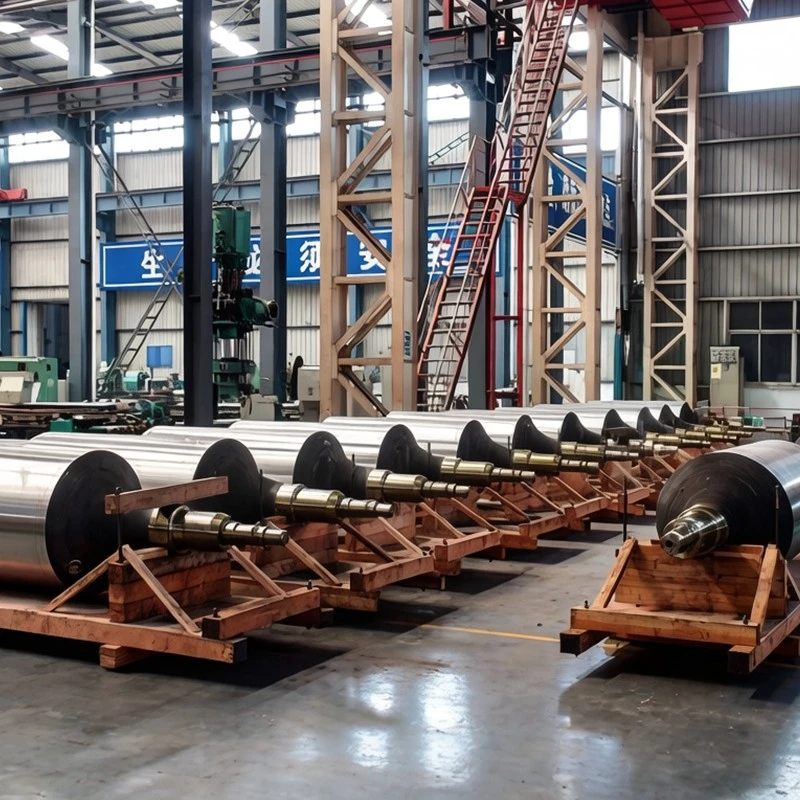
Hey there! As a supplier of Automatic Tracking Rollers, I've seen firsthand how cool these things are. They're a real game - changer in the industrial world, especially when it comes to adapting to different types of tracked objects. Let's dive right in and see how these amazing rollers do their magic.
Understanding the Basics of Automatic Tracking Rollers
First off, what's an Automatic Tracking Roller? Well, it's a piece of equipment designed to follow and handle different objects as they move along a production line. It's a crucial part of many industrial processes, making sure everything runs smoothly. You can learn more about it here.
These rollers use a combination of sensors, actuators, and control systems. The sensors detect the position and movement of the tracked object, and then the control system adjusts the roller's position and speed accordingly. This is what allows the roller to adapt to different objects.
Adapting to Different Sizes of Tracked Objects
One of the biggest challenges in tracking is dealing with objects of different sizes. Whether it's a tiny component or a large sheet of metal, the Automatic Tracking Roller has to keep up.
For smaller objects, the roller needs to be more precise in its movements. It uses high - resolution sensors to detect the exact position of the object. And the control system can make very fine adjustments to keep the object centered on the roller. This ensures that the object is handled gently and accurately.
When it comes to larger objects, the roller has to have enough power and stability. The design of the roller is such that it can support the weight of the large object without any issues. The control system also adjusts the speed and movement of the roller to match the size of the object. This way, the large object can be moved smoothly along the production line.
Handling Different Shapes of Tracked Objects
Objects come in all sorts of shapes - round, square, rectangular, or even irregular. The Automatic Tracking Roller has some neat ways to deal with these different shapes.
For round objects, the roller can use a special type of surface that provides good grip. This helps in rotating the object smoothly as it moves along. The sensors can also detect the curvature of the round object, and the control system can adjust the roller's movement to follow the curve.
Square or rectangular objects are a bit easier in some ways. The roller can use a flat surface to support the object. But the sensors still need to be on the lookout for any misalignment or tilting. The control system can then make quick adjustments to keep the object in the right position.
Irregular - shaped objects are the real challenge. The Automatic Tracking Roller uses advanced 3D sensors to map the shape of the object. Based on this map, the control system can calculate the best way to handle the object. It might need to adjust the roller's position and orientation multiple times to ensure that the object is moved safely.
Dealing with Different Materials of Tracked Objects
The material of the tracked object also plays a big role. Different materials have different properties, like friction, weight, and flexibility.
For objects made of slippery materials, like some plastics or metals with a smooth finish, the roller needs to have a surface with high friction. This could be a rubber - coated surface or one with a special texture. The sensors also need to be more sensitive to detect any slippage, and the control system can then increase the pressure or adjust the speed of the roller to keep the object in place.
Heavy - weight materials require a robust roller design. The roller needs to be able to support the weight without deforming. The control system also has to adjust the power and torque of the roller to move the heavy object efficiently.
Flexible materials, such as fabrics or thin sheets of metal, need a gentle touch. The roller's surface should be soft enough not to damage the material. The sensors can detect the stretching or bending of the flexible object, and the control system can adjust the movement of the roller to prevent any tearing or wrinkling.
Real - World Examples of Adaptability
Let's look at some real - world scenarios to see how the Automatic Tracking Roller adapts.
In a metalworking factory, the roller might be used to handle different types of metal sheets. Some sheets are thin and light, while others are thick and heavy. The roller can easily adjust its speed and pressure based on the thickness and weight of the sheet. This ensures that the sheets are rolled and processed without any problems.

In a packaging plant, the roller can handle different - sized and - shaped boxes. It can track the movement of the boxes along the conveyor belt and adjust its position to stack them neatly. Whether it's a small, square box or a large, rectangular one, the roller gets the job done.
Comparing with Other Similar Equipment
It's always good to see how the Automatic Tracking Roller stacks up against other similar equipment. Let's take a look at a few of them.
The Furnace Roller is mainly used in furnaces for handling materials at high temperatures. While it's great for its specific application, it doesn't have the same level of adaptability as the Automatic Tracking Roller when it comes to different types of objects. The Furnace Roller is more specialized for the high - heat environment in furnaces.
The Automatic Cable Coiler is designed specifically for coiling cables. It's very efficient at what it does, but its functionality is limited to cable handling. The Automatic Tracking Roller, on the other hand, can handle a wide range of objects.
The Heavy Duty Decoiler is used for unwinding heavy materials. It's strong and powerful but again, not as versatile as the Automatic Tracking Roller in terms of adapting to different object types.
The Radiation Furnace Tube is a key part of a radiation furnace. It's specialized for heat transfer and isn't designed for object tracking like the Automatic Tracking Roller.
Why Choose Our Automatic Tracking Rollers
Our Automatic Tracking Rollers are top - notch. We've spent a lot of time and effort in research and development to make sure they can adapt to all kinds of tracked objects. Our rollers are made with high - quality materials, so they're durable and reliable.
We also offer great customer service. If you have any questions about how the rollers work or need help in choosing the right one for your application, our team is always here to assist you.
Let's Talk Business
If you're in the market for an Automatic Tracking Roller, I'd love to talk to you. Whether you're running a small workshop or a large industrial plant, our rollers can make a big difference in your production process. They can improve efficiency, reduce waste, and save you money in the long run.
Don't hesitate to reach out if you're interested in learning more or making a purchase. We can have a detailed discussion about your specific needs and how our Automatic Tracking Rollers can meet them.
References
- Industrial Automation Handbook
- Journal of Manufacturing Technology
- Proceedings of the International Conference on Advanced Materials Handling