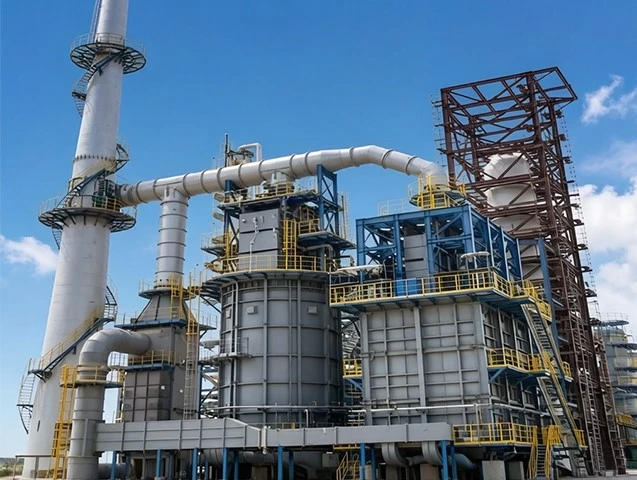

Petrochemical equipment related technologies mainly cover three major areas: design and manufacturing, operation and maintenance, and innovation and upgrading. The core technologies and their development status are as follows:
Core Equipment Classification and Design Technology
Petrochemical equipment is a general term for equipment used throughout the entire petrochemical process. It is divided into two main categories: static equipment and dynamic equipment. Different equipment design technologies have their own characteristics:
- Reaction Equipment: As the core equipment for raw material conversion, it requires customized design to meet complex process requirements. Currently, the mainstream technical routes include:
- Microchannel Reactor Technology: Possessing micron to millimeter-level reaction channels, it can increase mass transfer by hundreds of times and heat transfer by thousands of times, with near-zero scale-up effect and higher inherent safety. It is a popular research and development direction in recent years.
- Special Structure Optimization: For example, the nitration reaction unit patent disclosed by Sinopec enhances heat exchange through a reverse flow channel design, which can utilize reaction heat to save energy while simultaneously improving reaction rate and yield.
General Static Equipment:
- Heat Exchangers: As the leading drafting unit of my country's national standards for heat exchangers, Lanko High-Tech has long been deeply involved in the research and development of specialized equipment in this field and has formed a mature standardized design and manufacturing system.
- Pressure Vessels: There are clear national mandatory design standards requiring simultaneous compliance with three conditions: working pressure ≥ 0.1 MPa, working pressure × volume ≥ 2.5 MPa·L, and the medium being gas/liquefied gas/liquid with a boiling point above a certain level. Mandatory inspection is conducted by nationally designated agencies.
- Rotating Equipment: Includes pumps, compressors, fans, and other conveying equipment. Core technologies focus on sealing, vibration damping, and explosion-proof compatibility. For example, the sealing standard for petrochemical-grade oil-free compressors is three levels higher than that of ordinary industrial-grade compressors.
- Core Technologies for Operation and Maintenance "Petrochemical Equipment Maintenance and Repair Technology (2024 Edition)" compiles practical technologies from mainstream domestic petrochemical enterprises.
The main directions include:
- Condition Monitoring and Fault Diagnosis: Technologies such as online condition monitoring of pumps and turbines, infrared thermal imaging fault diagnosis, and intelligent operation and maintenance of large units have been widely adopted, enabling early prediction of faults such as vibration and leakage.
- Maintenance and Protection Technology: Covers practical techniques such as weld leak repair, lining modification and optimization, chemical cleaning, and corrosion protection. Mature material selection and protection solutions are available for high-sulfur and corrosive media.
- Energy-saving and intelligent applications: including new technologies such as flue gas recovery and energy-saving retrofitting, digital live well workover, and intelligent anti-pressure control, which have significant effects on cost reduction, efficiency improvement and safety enhancement.